The Generic Medicine
Ecosystem of India

- Team Members
- 4
- Timeline
- 4 weeks
- My Role
- End-to-end: Research to UI
- Tools
- Figma, FigJam
Introduction
The Jan Aushadhi scheme provides affordable, high-quality generic medicines to reduce healthcare costs across India. This project reimagines the experience by improving awareness, trust, accessibility, and overall user experience.
Branded vs generic vs Jan Aushadhi
| Branded medicines | Generic medicines | Jan Aushadhi medicines | |
|---|---|---|---|
| What it is | A medicine sold under a company’s own brand name | The same molecule sold under its chemical (salt) name or a lesser-known brand | Generic medicines sold through the government’s PMBJP scheme |
| Active ingredient | Same chemical compound | Same chemical compound | Same chemical compound |
| Price | Highest: pays for the brand and marketing | Lower, but the markup varies by chemist | Lowest: 50–90% cheaper than the branded equivalent |
| Where to buy | Any chemist | Any chemist, if the pharmacist stocks or suggests it | Jan Aushadhi Kendras only |
| Quality checks | Manufacturer’s own testing | Varies by manufacturer | WHO-GMP suppliers; every batch tested at NABL-accredited labs |
| How doctors prescribe | By brand name, the default habit | Rarely by name | Rarely: patient or pharmacist has to ask for the substitute |
| What buyers think | Trusted, because it’s familiar and costly | Unsure: quality feels unknown | “Too cheap to be real” |
Same medicine, three prices. The gap is trust, not chemistry.
Understanding The Landscape
Six reviews of the current app, quoted as written. Only one is about price, and it praises it. The rest are about stores that are shut, stock that isn't there and an app that doesn't work.
Existing App Reviews
Outdated record
One of the stores I tried to visit in Gurugram as per this app was shut as it was a year ago. Other one told me we don’t keep Jan Aushadhi medicine. 🤦🏻♂️ Record needs to be updated. Otherwise it’s helpful app.
Centre Closed
I called the nearest medical shop as per this app and the lady told me it is permanently closed. It should not be closed and the details should be updated.
App is dam slow
This rating is only for app it is dam slow... But this scheme is excellent and price of the medicines are very much affordable.
no availability
I want some products but salesman says ki यह सारी चीज़ें पिछले 6 महीने से नहीं आ रही है. यह बंद है वह काम में लिक कुछ रहे हैं हमारे पास मिलती है बांकी सरकार इसकी उल्लू बना रही है
App is not good
Please make negative rating arrangement so that we can give minus rating −10 −( * )
Jan Aushadhi Sugam App.
It's a very very badly designed app. Nothing works. Illogical requirements like it wants your email and email password for login to this app, which is very much bogus. Search medicines doesn't work. Even you can't give feedback in the app. Totally a bogus app. I don't know how a government app can be so illogical and bad.
Research Findings
The third-party lookup bottleneck
Operators must manually open Tata 1mg to translate prescribed brand names to look up their chemical composition, wasting valuable time.
Queues keep compounding
Each manual lookup holds up every customer waiting in line behind them, creating a massive bottleneck at the counter.
Health data is unprotected
A paper prescription slip is readable by whoever holds it, leaving sensitive medical information exposed and unsecured.
"Too cheap to be real"
Patients doubt the quality of inexpensive generics because price is often the only signal they have to judge the efficacy of the medicine.
Compositions nobody can pronounce
Patients struggle to pronounce or remember complex chemical names when asking the pharmacist for their medication.
Doctors can't see what was dispensed
Prescribers have no visibility into which specific generic substitute the pharmacist ultimately gave the patient.
Wasted trips to the Kendra
Patients frequently travel to a Kendra only to find out that their required medicine is currently out of stock.
No Kendra nearby
Patients struggle to locate nearby Kendras and lack the exact composition details needed to buy the generic alternative elsewhere.
User Research
Our team surveyed 60 people across four groups and ran 1-on-1 interviews with Kendra operators to understand how different user groups manage medical records, purchase medicines, and build trust with doctors and pharmacists. This helped us uncover key habits, behaviours, and pain points within the existing system.


Survey participants
| Participant Group | Count |
|---|---|
| Doctors | 12 |
| JA Customers | 26 |
| JA Kendra Operators | 6 |
| Non-customers | 16 |
User Personas
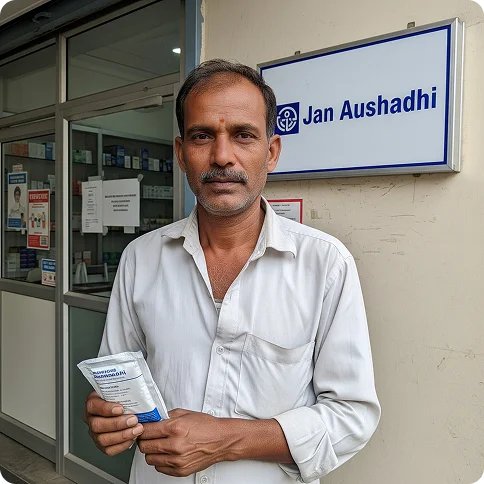
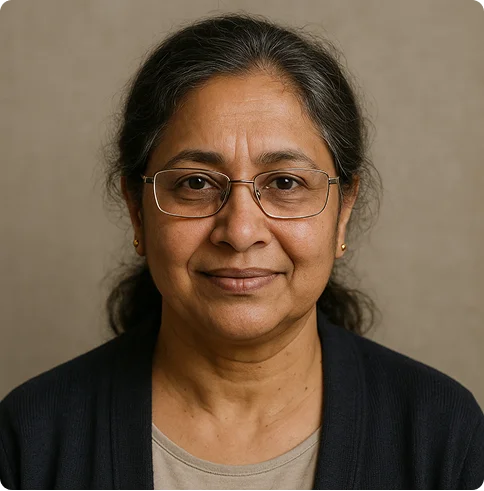
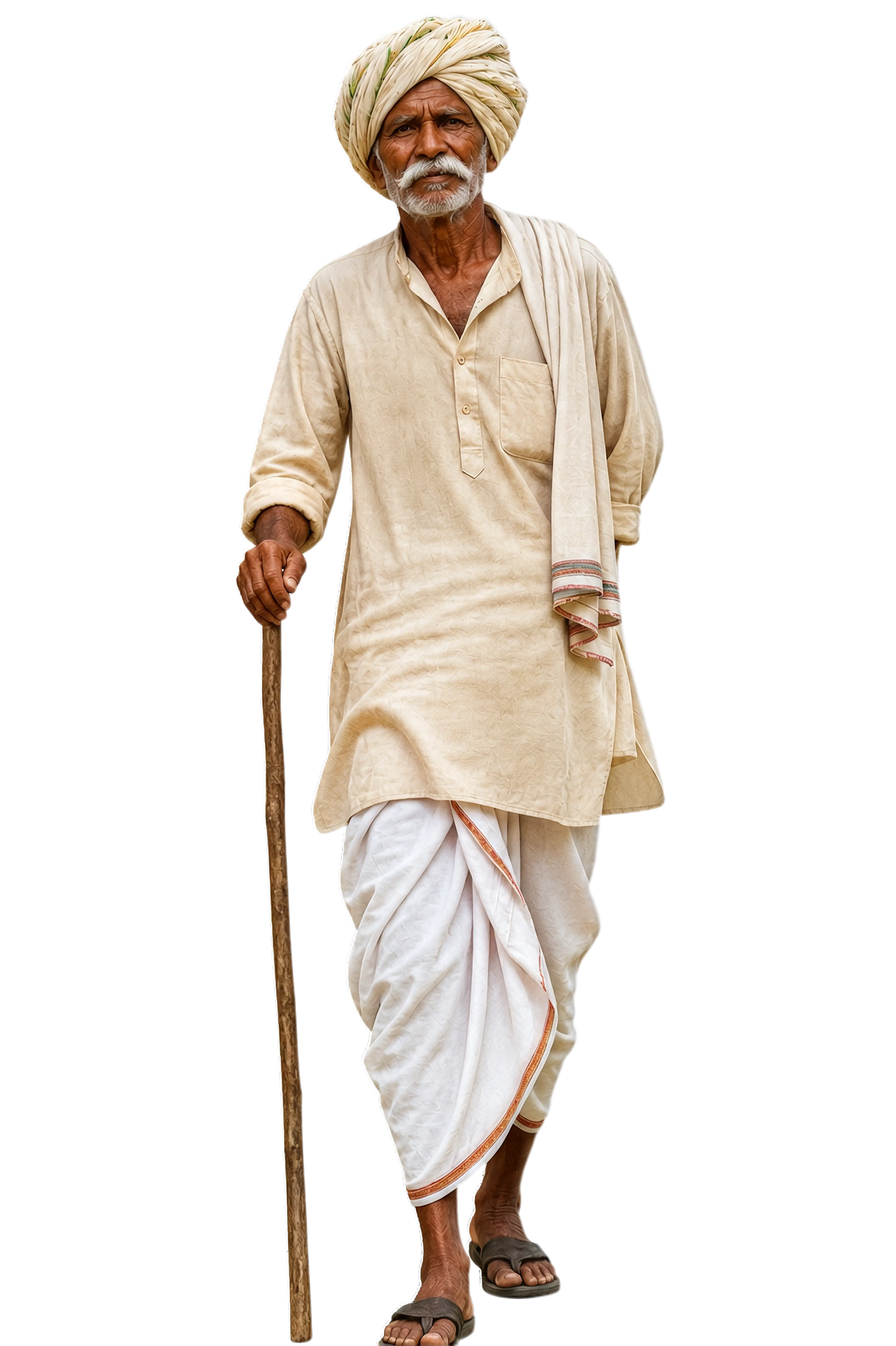
We synthesised our research into core user archetypes. These personas helped ground our design decisions in real user needs, focusing on accessibility for the elderly, convenience for caregivers, and clarity for new users.

Defining The Problem
Medicines are where the cost actually lands. They make up roughly 43% of out-of-pocket health spending in India, and for chronic conditions like hypertension and diabetes that cost returns every month.
Jan Aushadhi had already solved the price. What it had not solved was everything around the price. The research kept returning the same shape of problem from every side: patients read a low price as low quality and wait for a family doctor's approval that rarely comes; doctors hesitate to prescribe generics whose substitution they cannot track once the patient leaves the clinic; Kendra operators lose time and sales looking up compositions on third-party sites. Each group works from a different, partial view of the same prescription.
So the real gap was not affordability but the absence of a shared, trusted record linking the person who prescribes, the person who dispenses and the person who pays. How might we connect those three, so that choosing a generic becomes an informed decision rather than a leap of faith?
User Scenarios
Before designing anything, we mapped the journey as it runs today from the clinic to the counter and marked where it costs the patient time, money or confidence.
Doctor writes a prescription by hand
Brand names only. No composition, no record the patient keeps.
Patient carries the paper slip to a pharmacy
Lose the slip and the history is gone with it.
Pharmacist looks up the composition
Typed into Tata 1mg by hand, one prescription at a time.
A queue forms behind the counter
Every lookup holds up everyone waiting behind.
Medicine is dispensed, or it isn't
Stockouts send the patient to a costlier private chemist.
Today's flow. Each step hands the next one less information than it needs.
Solution
The proposal is a system rather than a better app: a Jan Aushadhi Unified Health Card, issued both physically and digitally, paired with a redesigned Jan Aushadhi app and connected by a shared Jan Aushadhi API that any hospital, clinic or pharmacy can use.
The card carries identity, which can also be accessed via the app. The API carries the record: prescriptions, lab reports, dispensed medicines and bills. Doctors, pharmacists and patients all read from that same record, and the patient controls who sees it and when.
System architecture
Data seamlessly synchronises between the centralised User Data servers and the Jan Aushadhi Health Card, with the Doctor and Pharmacist portals interfacing directly through dedicated APIs.
How it works
A basic workflow of the system.
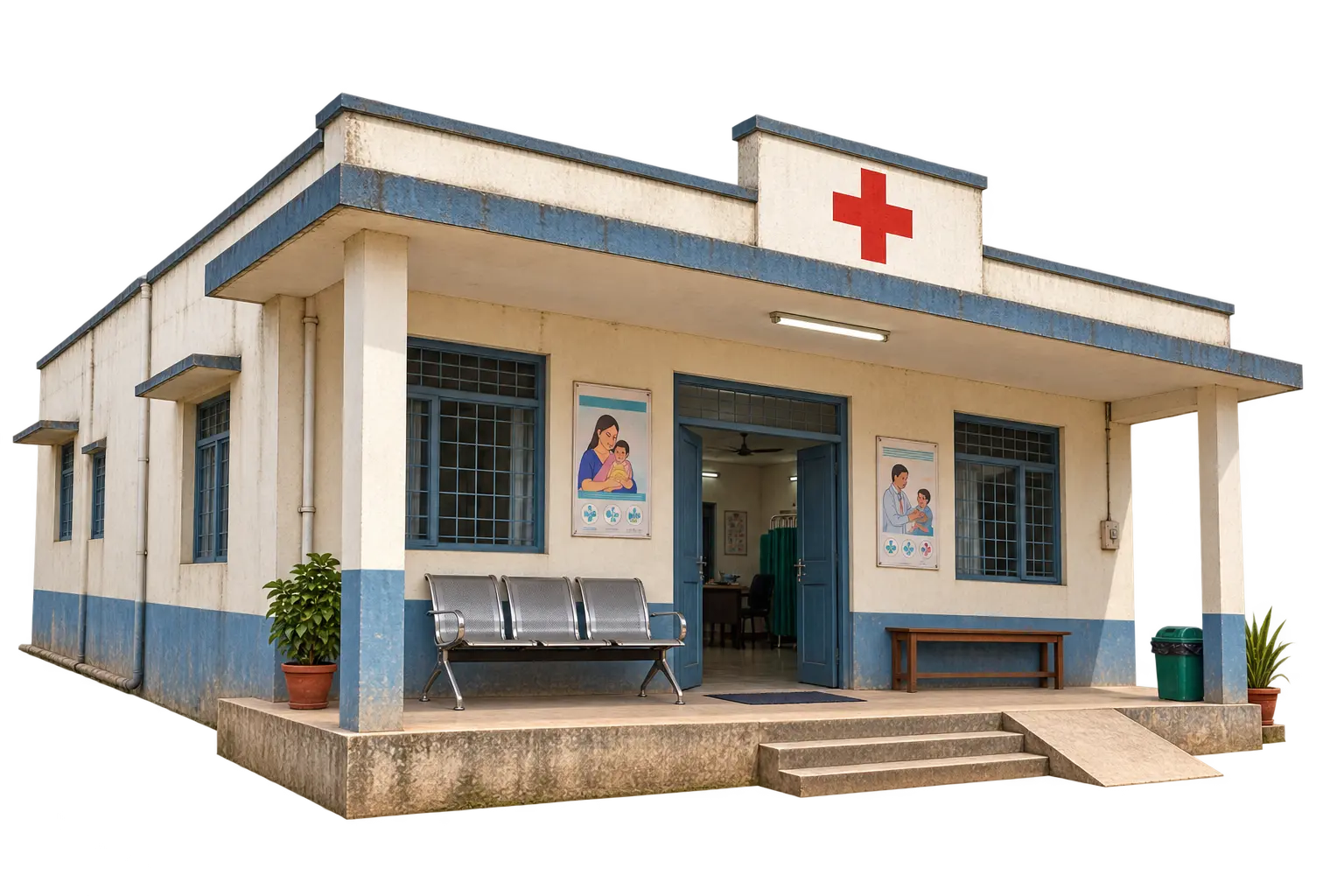

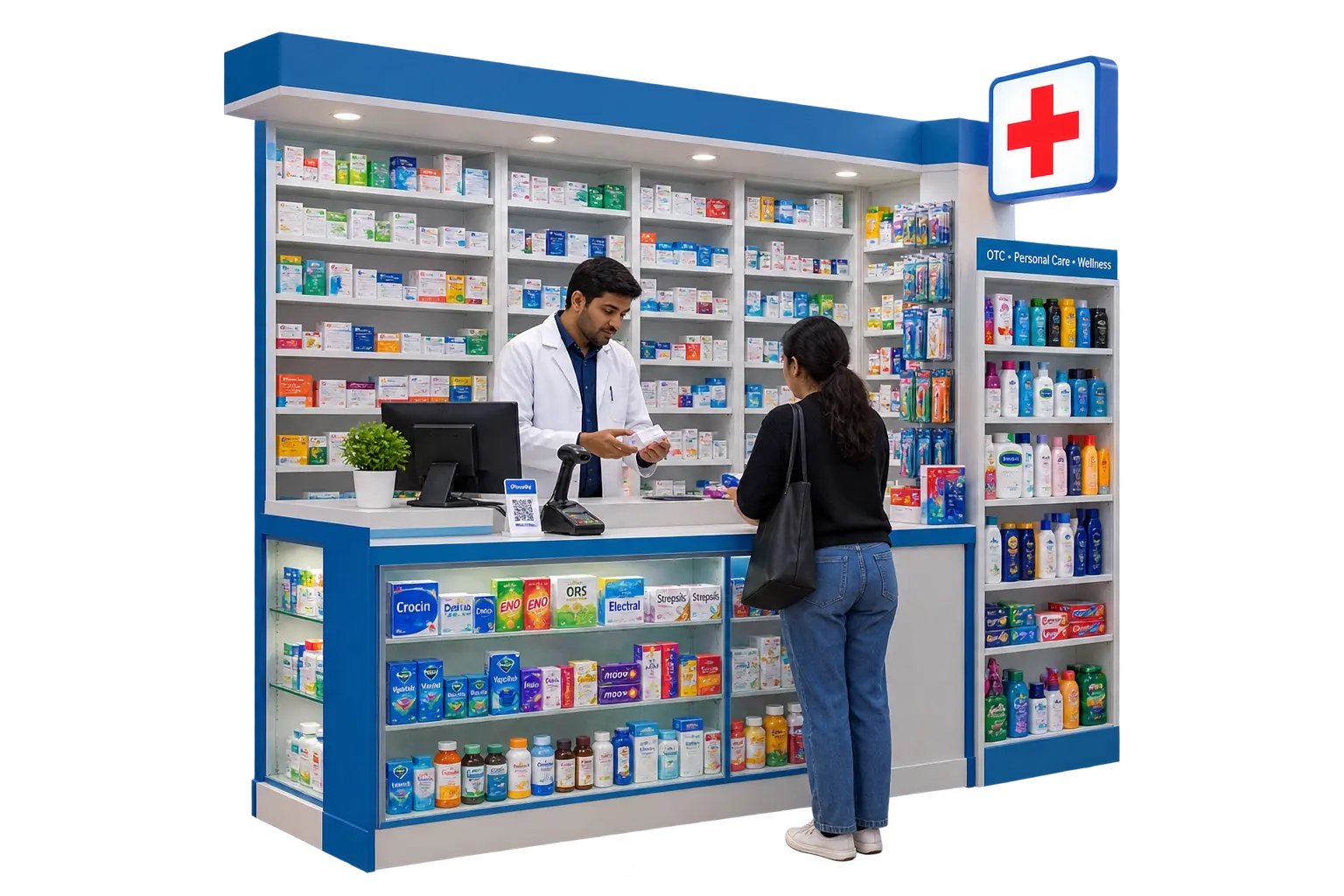

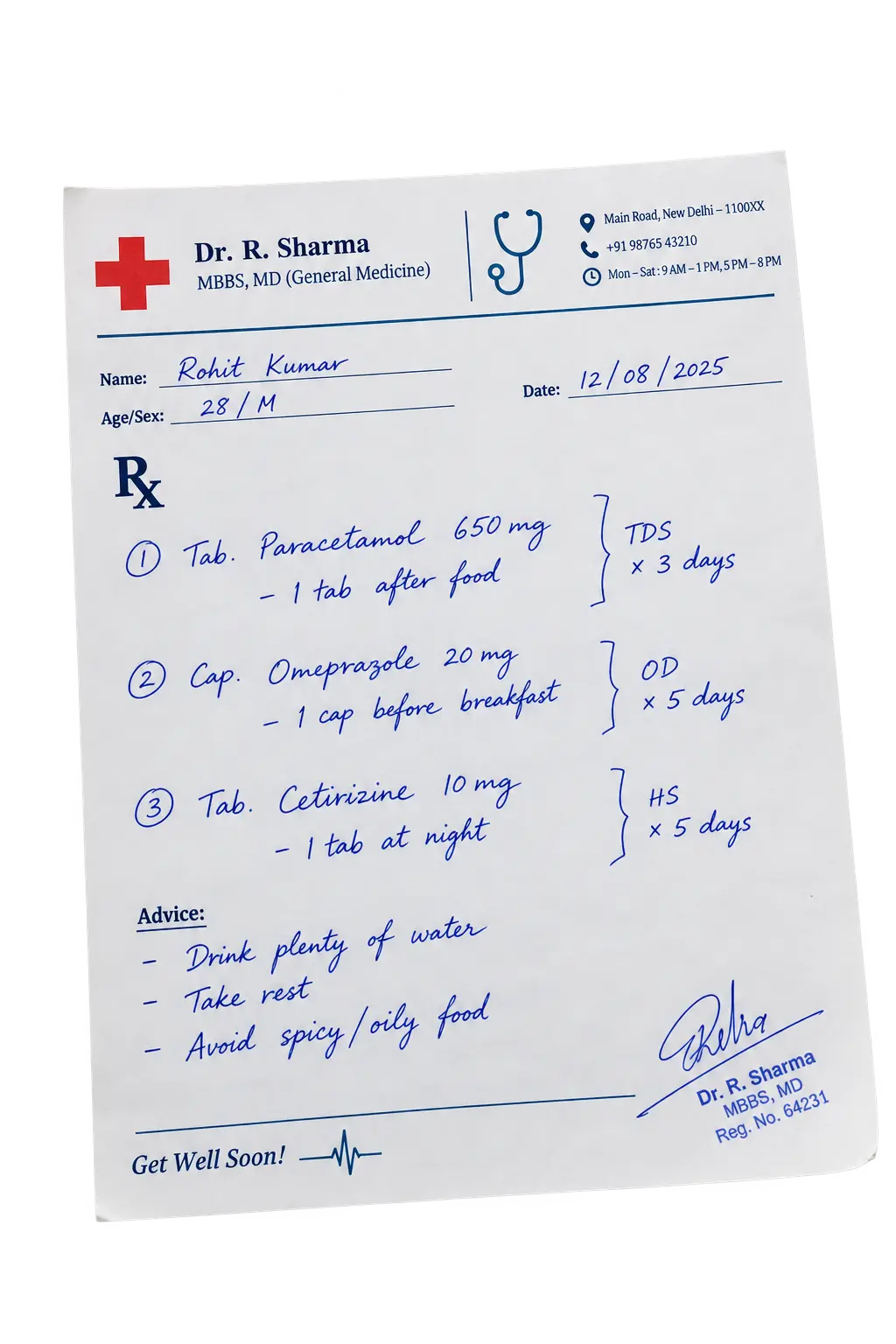
In the app
Medicine & pharmacy
Health records
Account & control
Digitising the prescription
Patients often misplace paper prescriptions, losing track of their medical history and reports. The unified card creates a secure, persistent digital record.
One change, three problems
A doctor prescribes by brand, and that habit is not going to change. So the system stops fighting it and carries the composition alongside whatever brand gets written. That single move turns out to close three separate findings from the research at once.
Prototype
The final high-fidelity prototype brings the new design system to life, featuring a clean, trustworthy aesthetic with clear typography and accessible colour contrast.